3D Printing Material Data Sheet | FDM, SLA, MJF, DMLS | Crenodez
3D Printing Material Data Sheet Library (FDM, SLA, MJF)
Choosing the correct material is the difference between a functional prototype and a failed part. At Crenodez, we believe in engineering transparency. Whether you are designing a high-load jig or a detailed visual model, you need accurate data to predict performance.Below is our comprehensive 3D Printing Material Data Sheet library. This resource allows engineers and designers to compare mechanical, thermal, and chemical properties across our Additive Manufacturing Material Standards.
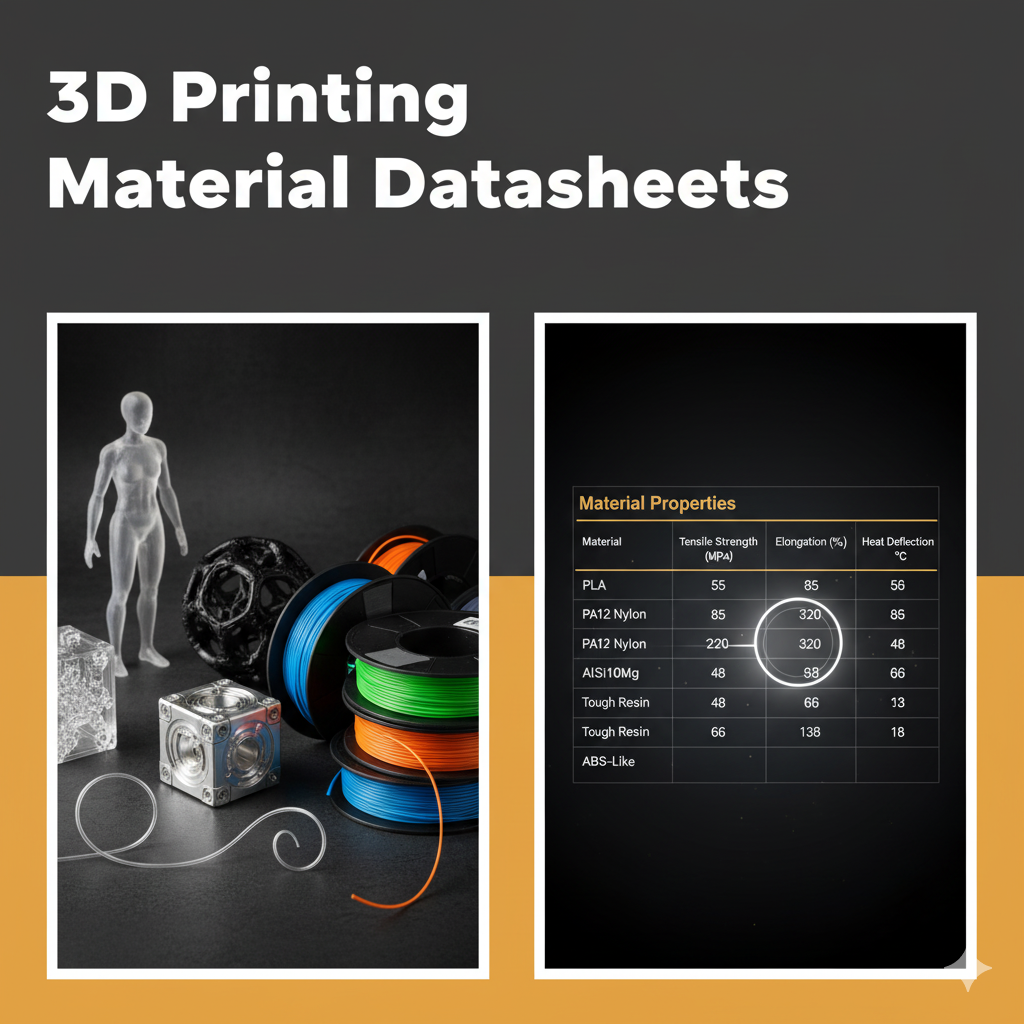
Understanding 3D Printer Filament Specs & Resin Properties
A datasheet is more than just a list of numbers; it is your guide to ensuring part viability. Our materials are tested against rigorous global standards, including ISO 527 Tensile Testing 3D Print protocols.
When reviewing these documents, focus on the metrics that match your application:
Tensile Strength: How much load can the part take before breaking?
Heat Deflection Temperature (HDT): At what temperature does the part deform under load?
Shore Hardness: How soft or hard is the flexible material?
FDM Material Properties Chart (Filaments)
Fused Deposition Modeling (FDM) is the standard for strong, cost-effective thermoplastic parts. Use the table below to compare PLA vs ABS technical data, as well as engineering-grade materials like Carbon Fiber and Nylon.
Best For: Jigs, Fixtures, Visual Prototypes, Functional Prototypes, and End-Use Parts.
Rigid, easy to print, great for visual models.
Tensile Strength: ~50 MPa
Heat Deflection Temperature: ~55°C
Polyethylene Terephthalate Glycol (PETG)
Impact resistant, translucent, chemical resistant.
Tensile Strength: ~50 MPa
Heat Deflection Temperature: ~70°C
Acrylonitrile Butadiene Styrene (ABS)
Durable, heat resistant, post-processable.
Tensile Strength: ~40 MPa
Heat Deflection Temperature: ~95°C
Thermoplastic Polyurethane (TPU 90A)
Flexible rubber-like material (TPU 95A Shore Hardness Data)
Tensile Strength: 35 MPa
Heat Deflection Temperature: ~95°C
Opaque white, excellent detail, paints well.
Tensile Strength: ~55 MPa
Heat Deflection Temperature: ~50°C
Tough, production-grade, similar to molded plastic.
Tensile Strength: ~45 MPa
Heat Deflection Temperature: ~60°C
Soft touch, simulates rubber gaskets/seals.
Tensile Strength: 8 MPa
Heat Deflection Temperature: N/A
Biocompatible, rigid, sterilizable.
Tensile Strength: ~50 MPa
Heat Deflection Temperature: ~75°C
DLP & SLA Resin Technical Specifications
Digital Light Processing (DLP) and SLA use liquid resins to create parts with isotropic strength and injection-mold-like surface finish. Unlike FDM, resin properties vary drastically depending on the post-curing process.
Best For: Intricate details, snap-fits, master patterns, and medical devices.
Multi Jet Fusion (MJF) – Material Data Sheet
MJF is the gold standard for batch production. These nylon-based powders create dense, non-porous parts.
Best For: End-use production runs, complex geometries, and durable mechanical parts.
Higher ductility and impact resistance than PA12.
Tensile Strength: 52 MPa
Heat Deflection Temperature: 180°C
Balanced properties, chemical resistant, watertight.
Tensile Strength: ~48 MPa
Heat Deflection Temperature: 175°C
MJF PA12 Glass Bead Datasheet (Stiff & Dimensionally stable).
Tensile Strength: 30 MPa
Heat Deflection Temperature: 175°C
How to Choose the Right Material?
If you are overwhelmed by the numbers, simplify your search by asking these three questions:
What is the max temperature?
< 50°C: PLA, Standard Resin.
< 80°C: PETG, ABS, PA12.
100°C: Nylon, High Temp Resin, PEEK.
Does it need to bend?
Yes: TPU, Flex Black, PA11.
No: PLA, ABS-CF, Rigid Resin, PA12 GB.
Does it look good?
Visual: DLP/SLA Resins (Smooth).
Functional: MJF / FDM (Textured/Layer lines).
Still Not Sure Which Material Fits Your Budget & Application?
Reading a datasheet is one thing; applying it to a project is another. Our engineering team at Crenodez reviews hundreds of CAD files every week.
Don’t guess. Let us guide you. Send us your design and requirements, and we will recommend the perfect material based on our internal testing data.